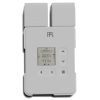
Real‑time monitoring and data‑logging platform with local display, alarms, and expansion‑module options for adding a broad array of measurements and applications.
Configure either an Ethernet sensor system using your building network or a wireless sensor system with our secure RF protocol to communicate between gateways and sensor devices. Our flexible systems can be configured with a mix of wired and wireless sensor devices. A traditional USB‑access data logger is available for a local‑only solution with direct‑connection data downloads.
Flexible, scalable, and customizable solutions to meet your application requirements.

Our N series gateways utilize a proprietary RF wireless protocol to communicate with remote sensors and control devices throughout a building. System gateways are accessed via an Ethernet connection to the building network.


High‑resolution display for sensor readings, logging setup, and calibration. System gateways also have audible alarms for monitoring sensor conditions and can be used to locate units.
All System Gateways can be expanded to include temperature and humidity sensors utilizing one of their two expansion ports and a DB module. DB modules provide a broad array of additional measurements including CO₂, motion, light, CT clamps, and temperature probes to expand gateway capabilities. Our System Gateways are flexible and can be configured as additional Ethernet monitoring devices within your sensor network.


In addition to expanding your monitoring system by creating a wireless network of multiple sensor devices, Gateways come standard with two expansion ports for any of our DB sensor modules. A 4‑port option is available to handle a higher count of measurement inputs.
DB expansion modules offer compatibility with external sensors such as temperature probes, flowmeters, and power‑usage meters.
Our modular design approach allows each unit to be customized around the application and to accommodate future expansion as monitoring requirements increase.

Multi‑point building monitoring system with gateways wirelessly communicating with sensor and control devices throughout a building. The system can monitor temperature, humidity, occupancy, CO₂, light, power meters, sub‑power, flowmeters, etc., with additional DB modules on gateway and device expansion ports. The system gateway is highlighted in the diagram below.


Configure for wireless communication with our secure RF protocol to our system gateways, or use an optional Ethernet interface via your building network for direct access to sensor monitoring and logging devices.
All Monitoring and Logging sensor devices have built‑in temperature and humidity sensors along with the two standard expansion ports for any of our sensor/input modules.
Standard with two expansion ports for any of our sensor modules. Optional data logger configurations are available with 4 and 6 expansion ports.
Built‑in sensors and expansion modules are compatible with external sensors such as temperature probes, flowmeters, and power‑usage meters.
Our modular design approach allows each unit to be customized around the application or to accommodate future expansion as monitoring requirements increase.
Local high‑resolution display for sensor readings, logging setup, and calibration. Gateways also have an audible alarm for monitoring sensor conditions and can be used to locate units.

Our sensor and control devices can be connected together to expand sensor and control capability at each device location for higher I/O count applications at power/electrical panels and to meet process‑automation/controller requirements.
Multi‑point building monitoring system with system gateways wirelessly communicating with monitoring devices throughout a building. The system can monitor temperature, humidity, occupancy, CO₂, light, power meters, sub‑power, flowmeters, etc., with additional DB modules on gateway and device expansion ports. Wireless sensor devices are highlighted in the diagram below.

Configure for wireless communication with our secure RF protocol to our system gateways, or use an optional wired interface via Ethernet and the building network for direct access to control devices.
Standard with two expansion ports for any of our control modules. Optional control device configurations are available with 4 and 7 expansion ports to meet any monitoring and automation application.
Add multiple relays and variable outputs to your monitoring system to automate alarms, process feedback loops, and control processes to increase efficiency.
Our modular design approach allows each unit to be customized with monitoring and controls configured around the application and capable of future expansion as requirements increase or change.

All control devices have built‑in temperature and humidity sensors along with the two standard expansion ports to mix DB sensor and control modules.
Compatibility with external sensors such as temperature probes, flowmeters, and power‑usage meters.
Local high‑resolution display for sensor readings, logging setup, and calibration. Monitoring and control devices also have an audible alarm for monitoring sensor conditions and can be used to locate units.
Our sensor and control devices can be connected together to expand sensor and control capability at each device location for higher I/O count applications at power/electrical panels and to meet process‑automation/controller requirements.
Add control devices to existing automation systems.

Multi‑point building monitoring and control system with system gateways wirelessly communicating with sensor and control devices throughout a building. The system can monitor temperature, humidity, occupancy, CO₂, light, power meters, sub‑power, flowmeters, etc., with additional DB modules on gateways and device expansion ports. Additional DB control expansion modules with relays and variable outputs can be programmed to automate control feedback loops. Wireless control devices are highlighted in the diagram below.

A traditional USB‑only data logger is available as a local solution with direct connection for downloading sensor data. An Ethernet‑connected data logger option is also available for remote access over building networks.
Local display for sensor readings, logging setup, and calibration. Data loggers also have audible alarms to alert users of critical sensor conditions.
All wired data loggers have built‑in temperature and humidity sensors along with two expansion ports for any of our sensor/input modules. Our loggers are flexible with “plug and monitor” expansion sensor modules that can be exchanged and configured for a variety of measurements.
Standard with two expansion ports for any of our sensor modules. Optional data‑logger configurations are available with 4 and 6 expansion ports.

Built‑in and compatibility with external sensors such as temperature probes, flowmeters, and power‑usage meters.
Our modular logger design approach allows each unit to be customized around the application with flexibility to adapt to different measurements by exchanging “plug and monitor” DB modules.
An optional, more cost‑effective unit without a display screen is offered for traditional data‑collection use. Our standard data loggers include a high‑resolution display for sensor readings, logging setup, and calibration for field convenience.
Storage capacity of 2 million samples with upgrade options of 128 million and 256 million points. With the optional SD‑card logger, storage can be expanded to up to 2 trillion samples.
Individual USB data‑logging system with loggers placed throughout a facility collecting sensor data. The system can be configured to monitor temperature, humidity, occupancy, CO₂, light, sub‑power, flowmeters, etc., with additional DB modules on each unit’s expansion ports. USB data loggers are highlighted in the diagram below.


DB sensor and control modules can be added to any N series gateway, device, or data logger through their expansion ports. The “plug and monitor” DB sensor modules are easy to install and expand the measurement capability of any N series device to a broad array of available sensors, probes and different DB built‑in measurements.
- DB31 Thermistor probes, 2 channels
- DB32 Thermocouple probe input
- DB33 3‑wire RTD temp probe input
- DB36 Onboard ambient temp & door position
- DB37 3‑wire RTD temp probe & door position
- DB1 Non‑isolated analog, 0‑10 VDC (CT clamps), 4 channels
- DB14 Pulse‑count / digital inputs (flowmeters), 4 channels
- DB18 Analog inputs, 4 channels VDC and mA
- DB15 CO₂ built‑in sensor
- DB50 Motion built‑in sensor
- DB13 Light built‑in sensor
- DB76 Differential pressure sensor
- DB77 Room differential pressure sensor
- DB80 RS232 with terminal block
- DB82 RS485 with terminal block
- DB100 Relay with terminal blocks
- DB110 Relay with standard plug
Offering built‑in sensors and controls through N series expansion ports.
Our modular design approach allows each unit to be customized around the application and to accommodate future expansion as monitoring requirements increase.
Add multiple relays and variable outputs to your monitoring system to automate alarms, process feedback loops, and control processes to increase efficiency.
Combine monitoring sensors with control mechanisms on individual devices.
Available DB modules for thermistor, thermocouple, and RTD probes as well as standard 4‑20 mA and VDC output sensors/transmitters. Include flow‑meter pulse‑count and power‑meter outputs with compatible DB modules.
Easily add monitoring points to existing building‑automation systems for improved control capability.
All Gateways, Devices and USB Loggers come standard with two expansion ports for DB sensor modules. An optional configuration with four expansion ports is available. Mix and match DB sensor modules to meet your application’s measurement requirements.
Multi‑point building monitoring system with system gateways wirelessly communicating with monitoring and sensor devices throughout a building. The system can monitor temperature, humidity, occupancy, CO₂, light, power meters, sub‑power, flowmeters, etc., with additional DB sensors and controls on gateway and device expansion ports. DB modules are highlighted in the diagram below.